THE PROBLEM
As products become configurable across variants, markets, and channels, most systems store data — but none compute validity across combinations.
Invalid Combinations Reach Production
Traditional systems allow incompatible options to coexist. Invalid SKUs are created before anyone detects them — often downstream in fulfillment, content, or operations.
SKU Explosion Becomes Unmanageable
Every new option multiplies combinations. Instead of defining logic once, teams manually author and maintain thousands of static SKU records.
Product Logic Is Fragmented
Pricing rules live in operational systems. Attributes live in catalog systems. Content rules live elsewhere. No single layer enforces compatibility across all of them.
Teams Compensate with Manual Workarounds
Validation happens in spreadsheets, QA, or human review. Launch cycles slow. Errors increase. Cross-team coordination becomes operational overhead.
THE INFRASTRUCTURE SHIFT
Instead of duplicating validation across PIM, ERP, and commerce platforms, define logic once in the engine. It derives only valid outcomes.
Components
Generate every size from a single core model
Rules
Generate every size from a single core model
Constraints
Generate every size from a single core model
Configuration Engine
Generate every size from a single core model
Valid Products
Generate every size from a single core model
Valid SKUs
Generate every size from a single core model
Channel Outputs
Generate every size from a single core model
Content Feeds
Generate every size from a single core model

One canonical product model
Define product components, rules, and constraints once. The engine computes every valid outcome — no duplication across systems.
Guaranteed Valid Outputs
Only valid products, SKUs, and channel feeds are generated. Invalid combinations never reach catalog, commerce, or operations.
Instant Impact of Change
Modify one rule or component and the engine recalculates all affected products automatically — across every market and channel.
Zero Manual SKU Authoring
SKUs are derived from logic, not manually maintained records. No spreadsheets. No reconciliation. No brittle data management.
How it works
The engine models product systems as structured components governed by deterministic rules and constraints. Every sellable output is derived from this model — never manually authored.
Objects
Objects represent the structured building blocks of a product system — modules, options, dimensions, finishes, or assemblies. Each object contains defined attributes that the engine understands, validates, and computes against.
Rules
Rules define how objects interact across the system. Compatibility, dependencies, substitutions, dimensional logic, and pricing behavior are authored once inside the engine and executed consistently everywhere.
Constraints
Constraints define the physical, operational, and commercial limits of a product system. They ensure that only viable combinations are computed across markets, channels, supply conditions, and manufacturing requirements.
Derivation
From objects, rules, and constraints, the engine deterministically derives valid products, sellable SKUs, channel configurations, and structured data feeds — without manual duplication or reconciliation.
Our solution
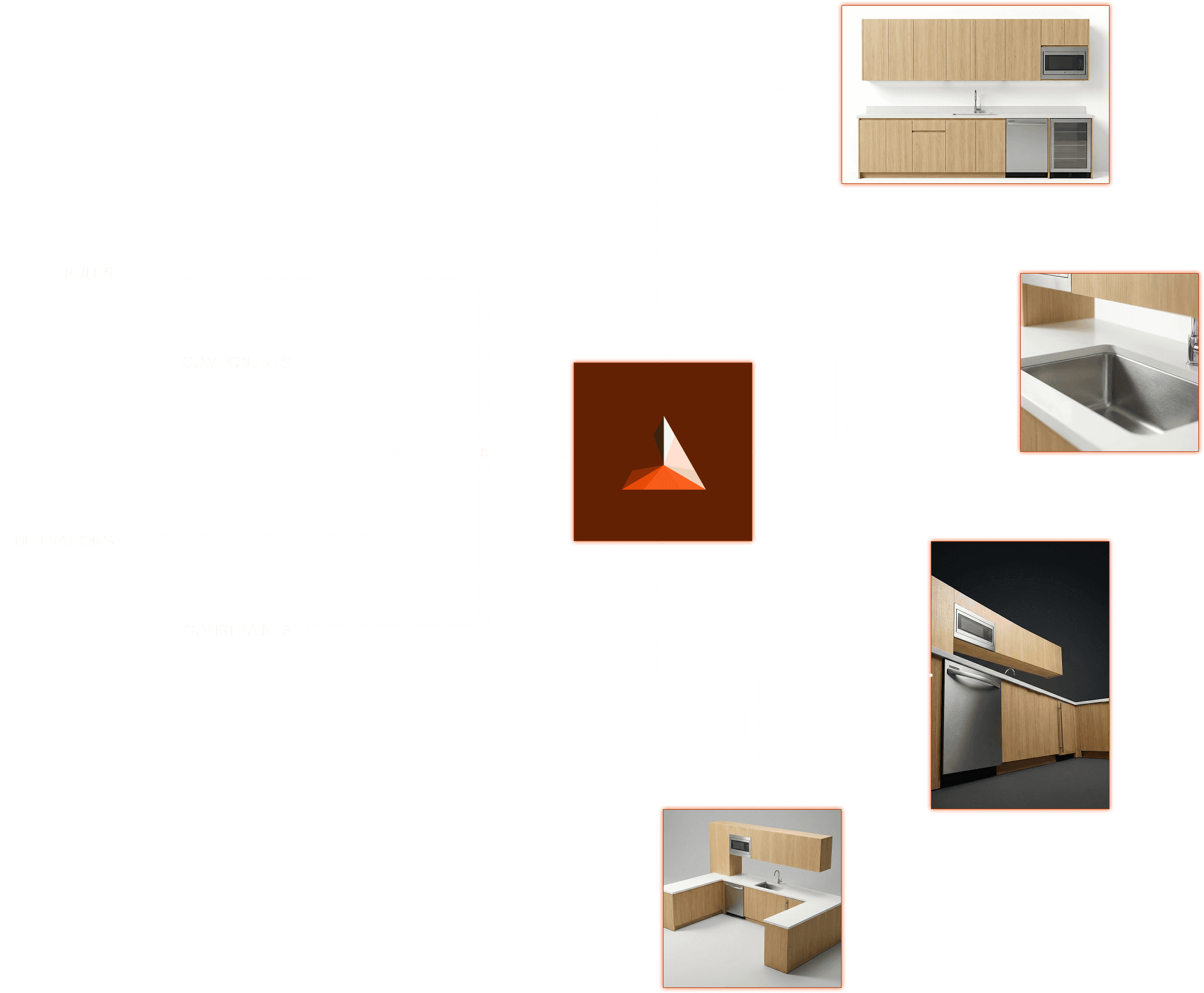
This configurable kitchen is modeled using components, rules, and constraints. Every dimension, material, and configuration state is validated and computed in real time — not manually authored.
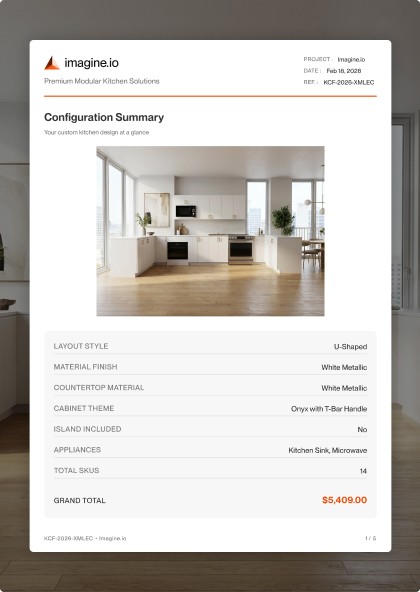
DERIVED OUTPUTS
The engine produces structured, channel-ready artifacts directly from the product model. No manual formatting. No duplicated data. No version drift.



WHO IT'S FOR
If your product has variants, options, dimensions, finishes, bundles, regions, or channel rules — this engine becomes your system of truth.
Product & Catalog
Define structured product systems once. Eliminate SKU explosion and manual compatibility management.

Engineering
Remove duplicated validation logic across services. Centralize computation and simplify system architecture.

Commerce
Ensure every channel receives only valid, consistent product data and assets.

%
Reduction in Manual SKU Maintenance
%
Validation Bugs in Production
%
Integration Logic Duplication
%
Time-to-Launch for New Variants
THE INFRASTRUCTURE SHIFT
API-first. Event-driven. Deterministic outputs.
Feeds PIM
Define product components, rules, and constraints once. The engine computes every valid outcome — no duplication across systems.
Feeds ERP
Feeds Commerce
Feeds Marketplaces
GET /configuration/{id} → Response: { "config_id": "cfg-2847", "valid": true, "skus_generated": 12, "channels": ["dtc", "marketplace", "eu"], "content_metadata": { "hero_image": "generated", "spec_sheet": "generated" } }
Manual SKU modeling cannot scale with variant growth. Infrastructure-level computation is required.

Meet with our specialists to review your current product architecture, identify where logic is duplicated or fragmented, and explore how a centralized computation layer can eliminate invalid SKUs and automate downstream outputs.